Arizona Holds Steady as Rest of U.S. Falls Back
The state has remained on Mountain Standard Time since 1968, a decision driven by summer heat and a desire for consistent evening schedules.
By Nikolai Patterson ·
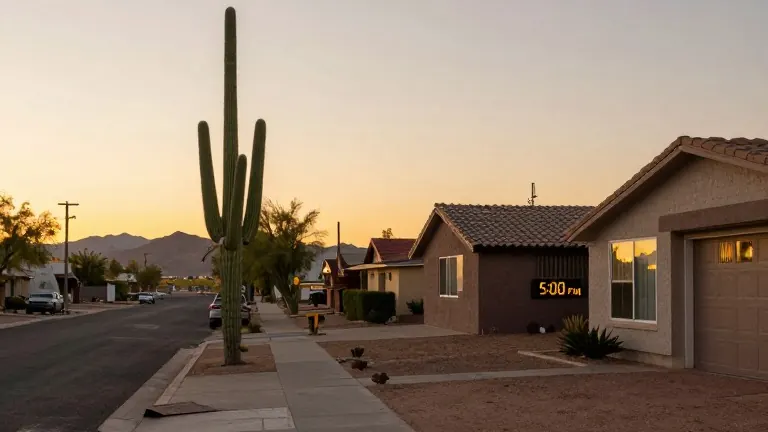
Phoenix residents wake up to the same morning light they saw the day before. While clocks throughout most of the country will move back one hour at 2 a.m. on Sunday, Nov. 1, the state of Arizona will keep its current time. This marks the continuation of a policy that has kept the Grand Canyon State on Mountain Standard Time for more than half a century.
Arizona stopped observing daylight saving time in 1967. The state made the decision permanent in 1968. The primary driver was the climate. During the intense heat of the Arizona summer, the extra hour of daylight pushed sunset later into the evening. Residents often had to wait until 9 p.m. to finish their outdoor activities, a delay that generated widespread dissatisfaction.
Before the state officially opted out, the practice had a complicated history. In 1918, the U.S. government recognized five time zones. When World War I began, the Standard Time Act instituted daylight saving time to conserve energy. A year later, the measure was repealed, leaving the issue to local jurisdictions. Phoenix and Maricopa County chose to stay on standard time, creating a split where the city operated in a different time zone than the rest of the state.
The confusion persisted until the mid-1940s, when wartime energy needs brought the practice back on a national level. After World War II, adoption varied by state. Congress passed the Uniform Time Act in 1966 to standardize the rules. This law included a provision for local exemptions, which allowed Arizona to formalize its break from the national schedule.
Hawaii joined Arizona in opting out in the same year, 1967. These two states are the only ones in the union that do not shift their clocks. Several U.S. territories also skip the change, including Guam, Puerto Rico, American Samoa, the Northern Mariana Islands, and the U.S. Virgin Islands.
Inside Arizona, the rule is not absolute. The Navajo Nation, which extends into northeastern Arizona, does observe daylight saving time. This creates a border where one community shifts its clocks while the neighboring Hopi Reservation, located within the Navajo lands, remains on standard time. The result is a complex patchwork of time observances across the region.
President Donald Trump has recently pushed for a national end to the twice-yearly clock changes. He urged the U.S. Senate to pass the Sunshine Protection Act, which would make daylight saving time permanent. The U.S. House of Representatives has already passed the measure. A March 2025 Gallup poll indicated that more than 50% of Americans are in favor of eliminating the practice.
For Arizonans, the upcoming weekend will be uneventful regarding time. There will be no need to adjust watches or digital devices. The state will continue to observe Mountain Standard Time, a status it has maintained without interruption since 1968.