Maryland Midterms: 604,000 ballots cast before Election Day
Thousands of trained volunteers staffed polling places to manage early voting surges in suburban counties.
By Nikolai Patterson ·
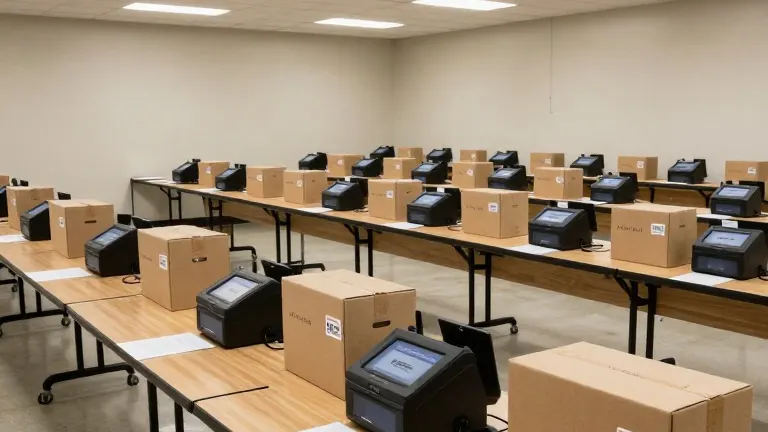
More than 604,000 Marylanders cast ballots during the early voting period that ended Thursday. The state Board of Elections released these unofficial figures as polling places closed for the day. Suburban counties bore a large share of the workload, with nearly 190,000 voters participating in Montgomery and Prince George’s counties from Oct. 22 to 29.
Election officials rely on a massive volunteer workforce to process these numbers. Thomas Hicks, former chair of the U.S. Election Assistance Commission, noted that the nation requires approximately 750,000 poll workers for presidential cycles. He stated that this midterm election is generating similar staffing demands. Without adequate coverage, officials warned that the voting process could face operational disruptions.
At the Activity Center at Bohrer Park in Montgomery County, nearly 40 poll workers began their shifts at 6 a.m. The site, one of 102 early voting centers in the state, operated until 8 p.m. Workers checked in voters, provided ballot marking devices, and directed individuals to scanning stations. Gilberto Zelaya, a community engagement officer for the Montgomery County Board of Elections, assisted voters who appeared confused about the equipment. He directed one man to a scanning station and thanked him for participating.
Delia Millet, a 64-year-old volunteer in Prince George’s County, has served at polls for nearly 30 years. She described her role as a civic duty and a way to support voters who may struggle with the process. Millet often helps elderly voters who need physical assistance and encourages first-time young voters. Her experience began as a way to diversify her professional background but evolved into long-term community involvement.
Rick Reinhard, 71, joined the workforce in Montgomery County during the 2020 presidential election. He cited the role as a productive use of his retirement. Volunteers must pass a quiz and complete a three-hour in-person training session before each election. The curriculum covers station responsibilities and equipment operation. Reinhard, a retired nonprofit executive, said the rigorous preparation leaves little room for error.
Hicks said poll workers often face voter frustration stemming from political narratives about election integrity. He clarified that volunteers primarily guide the casting process rather than manipulating outcomes. Zelaya, who joined the board in 2003, founded Future Vote in 2004 to educate students. The program allows middle and high schoolers to serve as Election Day aides, aiming to teach younger generations the mechanics of voting.